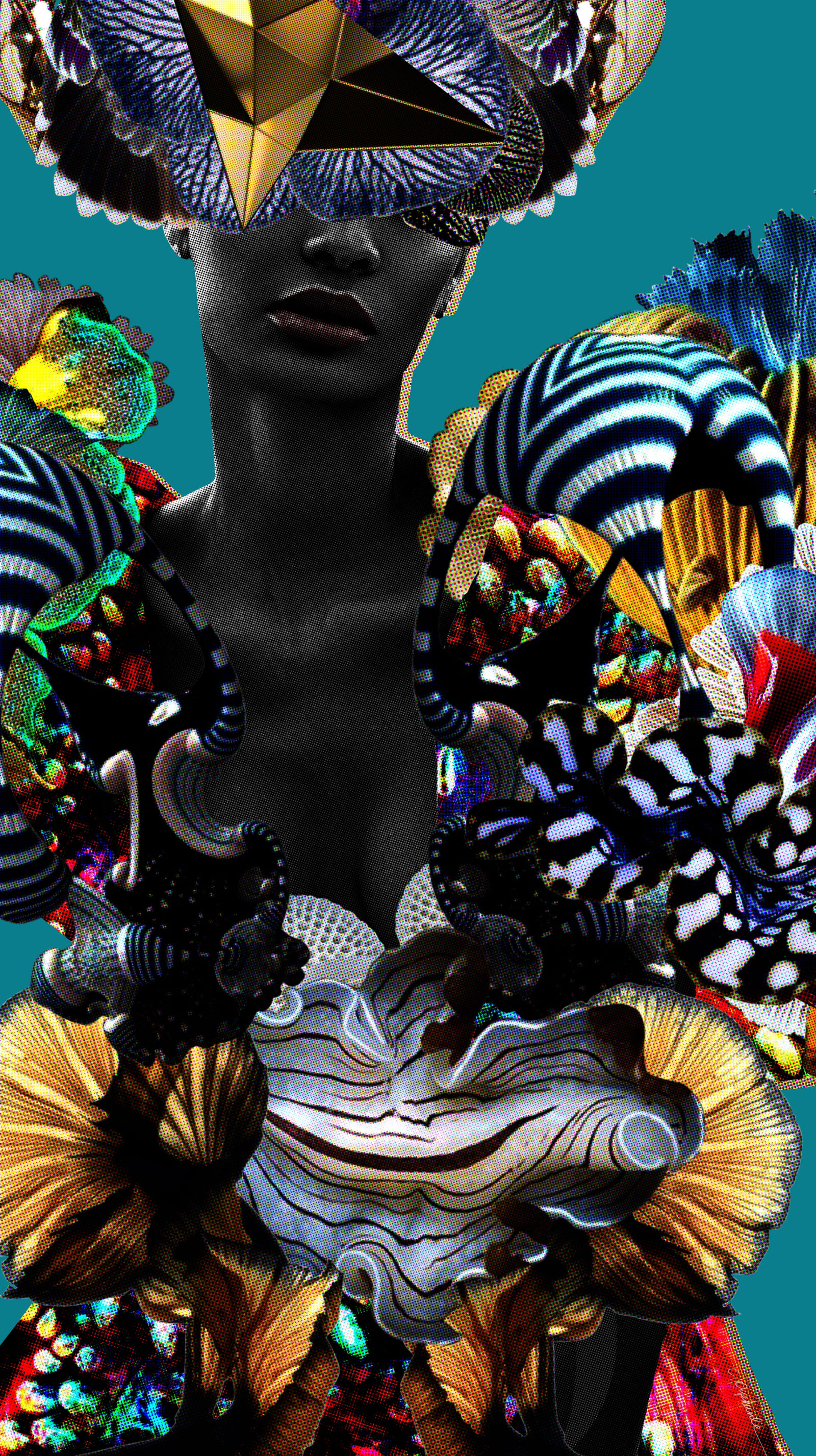
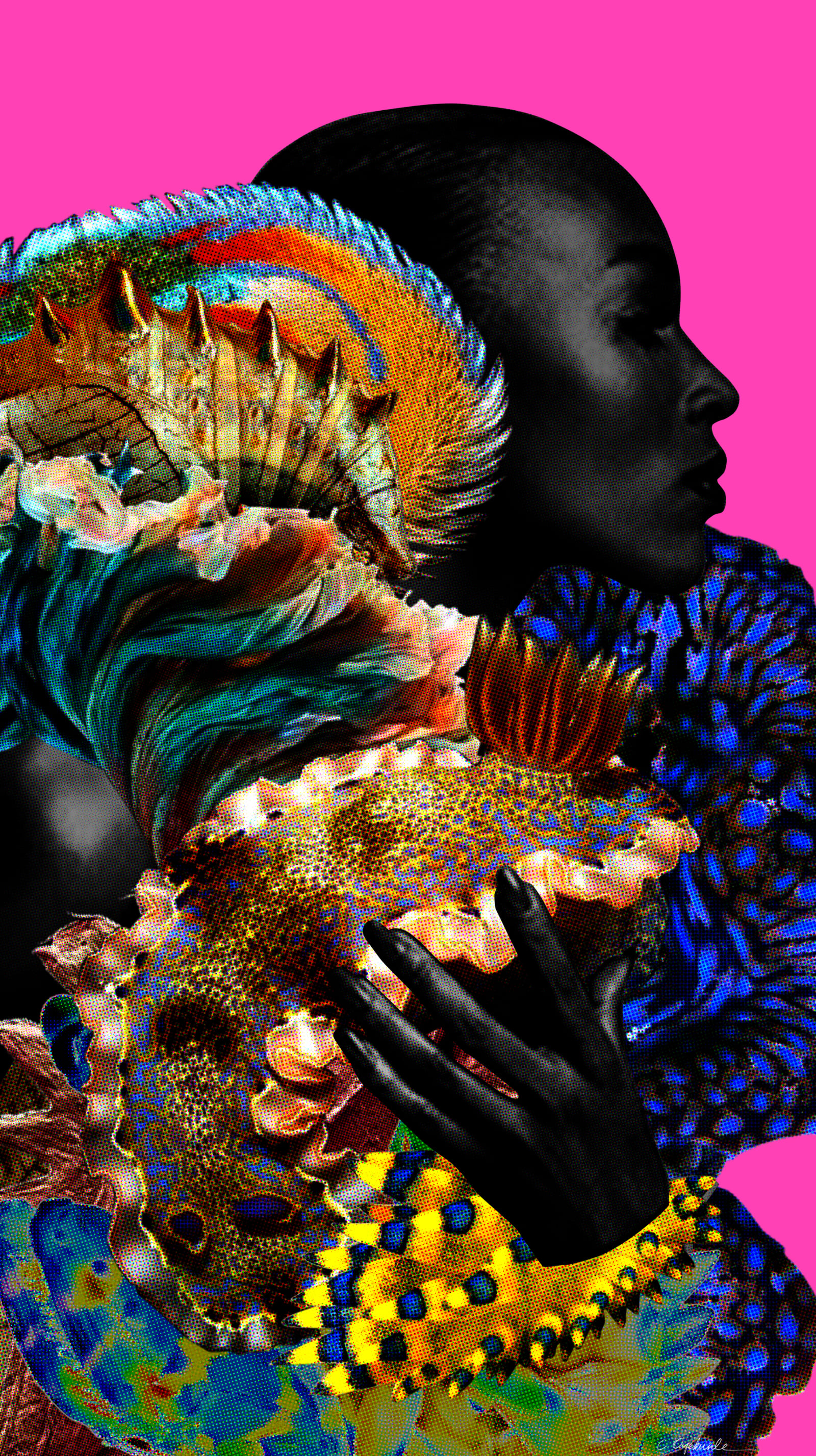
Carol Muthiga-Oyekunle is a Kenyan-American artist and designer. Her work is influenced by her background in graphic design and her career as a luxury accessories designer. Based in Paris, she holds an MA in Fashion from the Royal College of Art in London. Under her artist pseudonym, inspired by the names of her daughters, Chiara Lola and Siena Lorenza, Lolita Lorenzo works across multiple mediums: eyewear, clutches, jewelry, interior design, illustration, and fine art. This interdisciplinary approach shapes her aesthetic identity. “Her hair is her adornment, and her clothes are her armor.” In Carol Muthiga-Oyekunle’s works, women are depicted as symbolic warriors, radiating strength and joy. The artist skillfully interweaves digital and mixed-media collage techniques, photography, and vibrant graphic elements to create bold and brilliant portraits of her female subjects. The resulting works depict themes from the past, the present, and imagined futures, and hold up a mirror to a patriarchal society. Carol draws inspiration from her daily life, from faces she passes on the street to close friends she admires. Her experimental approach involves fusing disparate elements and styles into a coherent whole; it is these contrasts that add the touch of magic inherent in all her works. Her diverse and multifaceted technique draws on a wide range of classical and modern influences : from Klimt, Matisse, Moser, Mucha, Avedon, Warhol, and Lichtenstein to her contemporaries Kehinde Wiley, Yinka Shonibare, Nick Cave, Bisa Butler, and Wangechi Mutu. Finally, her creative process explores culture, tradition, and Afrofuturism: an artistic and philosophical movement that envisions a futuristic, high-tech African diaspora, where racial equality is a reality rather than an idea. The artist herself describes her subjects as “intergalactic.”

The originality and quality of her art have led her to collaborate on projects with brands such as Visa, Westfield, Motiva, and Marché Noir Lomé Paris. She has also created covers for Lumas Gallery, Empower magazine, and other publications.


Carol_Muthiga-Oyekunle_Collage.jpg

A S E T - vertical

A_S_E_T_-_vertical_Carol_Muthiga-Oyekunle_Collage.mp4

The warrior presented here embodies the Egyptian deity Aset. Isis, by its Egyptian name Aset, is the ancient goddess of fertility, motherhood, magic, healing and rebirth. She is the companion of God king Osiris.

technique

collage

format

portrait

duration

00:36

year

2023

Transport

WANT TO BRING ART INTO YOUR SPACE?

More from Carol Muthiga-Oyekunle

More on digital art

Generative art
Generative art refers to a way of creating artworks using an autonomous system. In digital art, these are usually generated from code and algorithms created by the artist, often with certain predefined parameters or systems. Although these parameters guide the final outcome of the work, generative art is generally a surprising way to create artworks, as the results are often unexpected and the number of possible outcomes can be infinite.
AI
AI art is a branch of generative art that uses artificial intelligence. Unlike other generative artworks, AI artworks use specific complex algorithms and models derived from machine learning. The most common methods for creating AI art today are GANs (generative adversarial networks) or proprietary prompting platforms such as ChatGPT, Sora, Midjourney, or Dall-e.
3D
3D art uses 3D software such as Blender, Cinema4D, Houdini, or video game software such as Unity to create works of art. In 3D works, artists can either arrange assets (the 'objects' in a 3D artwork or world) that they have created themselves or purchased from other creators to create elaborate environments and scenes (an approach to 3D art called 'set dressing'), or specialize in sculpting, which involves creating their own objects and assets.
Photogrammetry
Photogrammetry is a specialized 3D technique that allows 3D objects to be created from numerous photographs taken of an object or scene from multiple angles. These photos are then compiled to determine the specific positioning, shape, and dimensions of the object in space, and then converted into a 3D model. Initially developed for engineering and urban planning, photogrammetry has become a way for artists to produce extremely accurate 3D models from real-life images.
Collage
An extension of the traditional, plastic approach to collage, digital collage involves searching for and cutting out multiple images, extracting them from their original context, and recomposing them in a new arrangement to create a work of art. Artists can use their own photographs or find images on the internet.
Illustration
Digital illustrations are created using software such as Adobe Illustrator, Photoshop, or Procreate. As with drawing on paper, the artist uses a stylus to sketch a figure or object, usually on a tablet, to construct a scene or artistic universe. Unlike traditional drawing methods, digital illustration is much more forgiving, as mistakes can be easily corrected and drawn elements and objects can be easily moved around within a scene.
Video
Video artworks primarily use a recording camera, but may sometimes include additional post-processing or editing to distort, modify or add additional elements to the image. Some artists use state-of-the-art recording equipment to create macro zoom-ins or time lapses, privileging fidelity to the subject matter. Others use additional softwares to significantly modify or warp the video, creating an alternative perspective on the world that surrounds us.

Collections with the artist

  • The_Kiss__Shavonne_Wong_3D.mp4
    United in Diversity
    29 artworks
  • Natural_Flow_1_Kenneth_Wayne_Alexander_II_Collage.mp4
  • You_are_Intriguing_Tishk_Barzanji_3D.mp4
  • Pink_Girl_Dancing_Luzroja_Video.mp4
  • Lit_friday_night_Gavin_Shapiro_3D.mp4
  • Great_Piece_of_Australia_II__Luke_Conroy_3D.mp4
  • POOLOOP_Jules_Langeard_Video.mp4
  • Dragon_Céline_Shen_Video.mp4
  • Where did you scan from

    RATE YOUR EXPERIENCE