sea the wall 1
sea the wall 1
- Collage
- Architecture
- Meditative
- Landscape
landscape
collage
01:00
2023

Between Worlds - Horizontal
rokkankim (kim jonghyuk)

sea the wall 4
rokkankim (kim jonghyuk)

sea the wall 43
rokkankim (kim jonghyuk)

skyline tide - Horizontal
rokkankim (kim jonghyuk)
sea the wall 1
rokkankim (kim jonghyuk)

Between Worlds - Vertical
rokkankim (kim jonghyuk)

sea the wall 5
rokkankim (kim jonghyuk)

sea the wall 2
rokkankim (kim jonghyuk)
Rokkan Kim began his artistic practice with digital collage after gaining diverse experiences as the founder of the fashion brand ROKKAN, as well as working as a film producer and exhibition director. His current practice spans media art, sculptural lighting works, painting, and AI-based processes, through which he explores the layered structures of time, memory, and history. Kim’s work focuses on the duality of historical perception—the idea that a single event can be interpreted in radically different ways depending on ideology and perspective. Rather than reproducing established narratives of the past, he collects fragments of records and historical facts and rearranges them into new visual constellations through collage.
Positioned as an observer outside the frame, the artist traces the presence of individuals who have disappeared within vast social and historical structures, constructing visual environments where expansion and conflict coexist. Through the interplay of light, moving image, and material surfaces, Kim creates spaces that do not directly reveal emotion but instead leave room for contemplation, inviting viewers to construct their own meanings and interpretations.
sea the wall 1
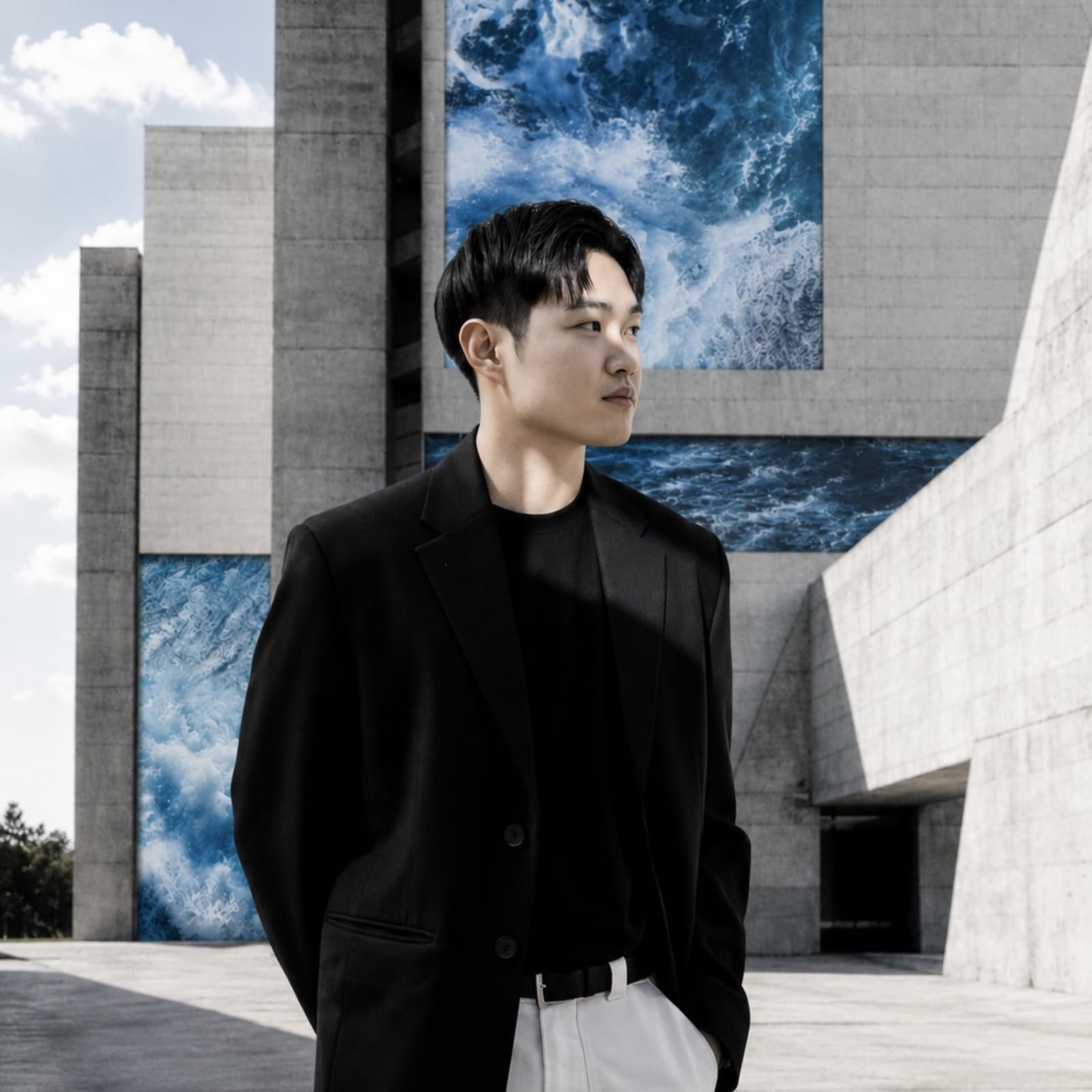
SEA THE WALL embodies the layered meanings of both “the wall of the sea” and “seeing the wall.”
For centuries, the sea has been both a source of survival and an insurmountable boundary for humanity. Through the sea, civilizations expanded trade networks and pursued their desire to discover new lands. Yet this same pursuit has also contributed to environmental destruction and the climate crisis. The fractures created by human ambition have ultimately revealed the immense power of nature, reminding us that the sea brings both prosperity and fear.
Within the series, architecture symbolizes humanity’s pursuit of order, control, and permanence. The sea, in contrast, represents the unpredictable force of nature and its constant state of transformation. Massive concrete structures confront endless waves that erode, dissolve, and redefine their boundaries, creating an ongoing dialogue between the artificial and the natural.
For me, the sea is a place where fear and comfort coexist. As a child, I nearly drowned, an experience that left me with a profound fear of water. Yet over time, the sea also became a place of contemplation and peace when observed from a distance. This contradiction serves as the foundation of SEA THE WALL. The small human figure that repeatedly appears throughout the series represents both myself and ourselves. Standing between architecture and the sea, the figure becomes an observer confronting the relationship between human civilization and nature. Viewers are invited to project their own memories and experiences onto the work, encountering a sea that is uniquely their own.
Through painting, sculpture, light, and moving image, SEA THE WALL visualizes the moments when nature and the artificial, creation and destruction, fear and comfort collide. Water is gentle, yet impossible to contain. Walls appear permanent, yet are inevitably subject to fracture and decay.
Humanity builds walls, and the sea breaks them down.
Within this endless cycle, the work poses a simple question:
Where do we stand?
And when the wall disappears, what will you see?
collage
landscape
01:00
2023
More from rokkankim (kim jonghyuk)
More on digital art
Collections with the artist