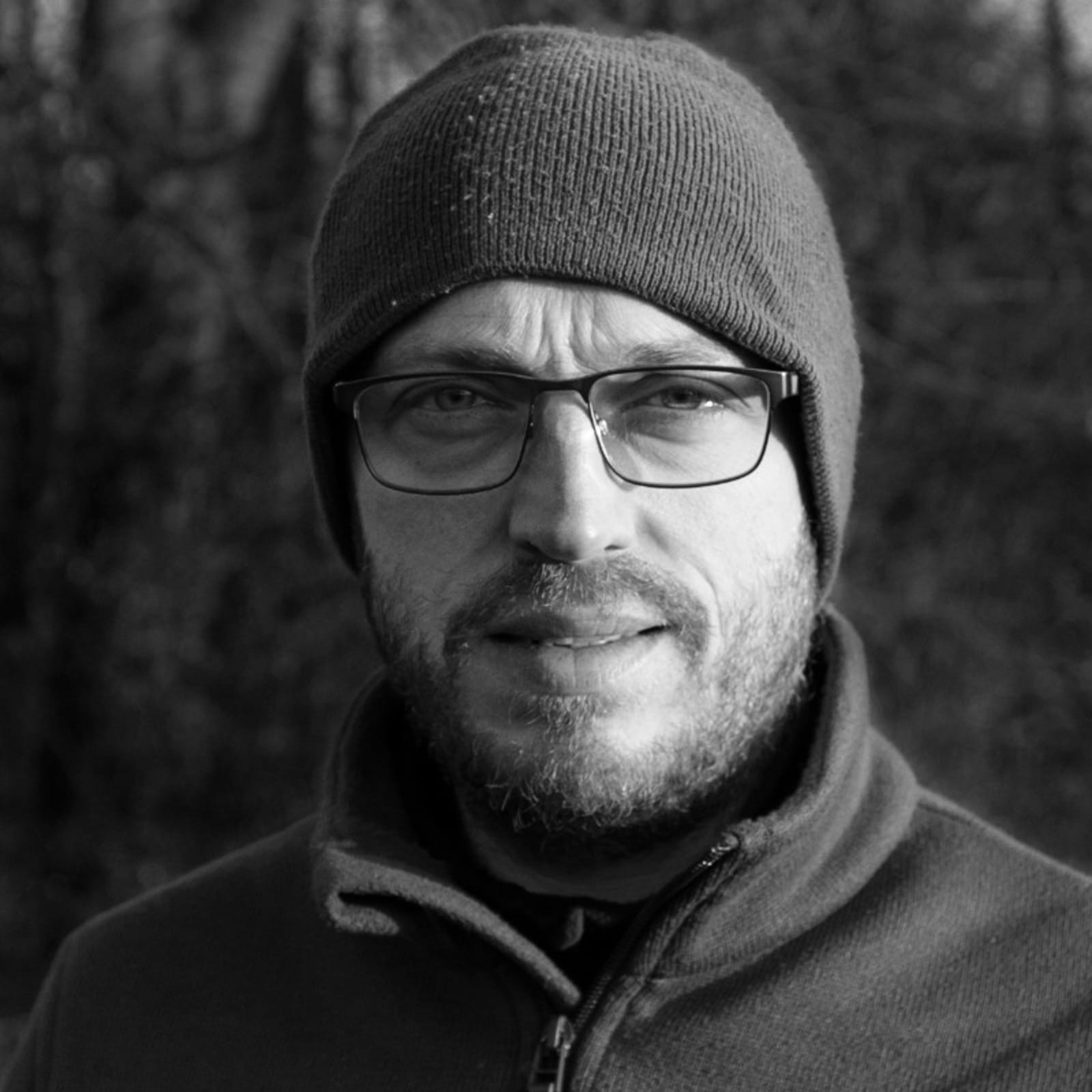
Luigi Honorat is a French artist based in Tokyo. He studied sculpture at Musashino Art University in Japan, before becoming a professor there himself. His practice explores sculpture free from material constraints, through digital studies and the decomposition of volumetric forms, both classical and abstract. It is in his Intangible series, begun in June 2017, that this exploration comes into its own: each study, completed in a single day and focused on a single idea, explores the possibilities of procedural modeling and animation. The starting point for this approach is as pragmatic as it is conceptual: the lack of a studio and storage space, constraints inherent to the practice of sculpture in a city with limited space like Tokyo. However, he never compromises on sculptural coherence; although entirely designed in 3D, each piece retains certain limitations of physical sculpture, occupying a given space and using only one type of material at a time, so that each digital work could, hypothetically, be transformed into a real sculpture.

Luigi Honorat has worked for major brands such as Apple and has exhibited on numerous occasions in France and Japan, including at the National Art Center and the Fuchu Art Museum in Tokyo, as well as at the Ome Art Festival. His work earned him the Takashi Shimizu Award in 2015. His practice also extends to musical collaborations: he has created visuals for several artists, including Micka Luna, Ian Chang, and Lee Ranaldo.


Luigi_Honorat_3D.png

Intangible - selection

Intangible_-_selection_Luigi_Honorat_3D.mp4
The Intangible series is an ongoing form study exploring the possibilities of modeling and procedural animation. Started in June 2017, each study was completed in one day and focused on a single idea. Although it is entirely made in 3D, the series retains some of the limitations of physical sculpture as it unfolds in a particular space, using only one type of material at a time. Each study is carried out so that, hypothetically, the work rendered in 3D can be transformed into a physical sculpture. The starting point of this series was the lack of studio space and storage and the difficulties of working in sculpture in a limited space city like Tokyo.
technique

3d

format

landscape

duration

03:49

year

n/a

Transport

WANT TO BRING ART INTO YOUR SPACE?

More from Luigi Honorat

More on digital art

Generative art
Generative art refers to a way of creating artworks using an autonomous system. In digital art, these are usually generated from code and algorithms created by the artist, often with certain predefined parameters or systems. Although these parameters guide the final outcome of the work, generative art is generally a surprising way to create artworks, as the results are often unexpected and the number of possible outcomes can be infinite.
AI
AI art is a branch of generative art that uses artificial intelligence. Unlike other generative artworks, AI artworks use specific complex algorithms and models derived from machine learning. The most common methods for creating AI art today are GANs (generative adversarial networks) or proprietary prompting platforms such as ChatGPT, Sora, Midjourney, or Dall-e.
3D
3D art uses 3D software such as Blender, Cinema4D, Houdini, or video game software such as Unity to create works of art. In 3D works, artists can either arrange assets (the 'objects' in a 3D artwork or world) that they have created themselves or purchased from other creators to create elaborate environments and scenes (an approach to 3D art called 'set dressing'), or specialize in sculpting, which involves creating their own objects and assets.
Photogrammetry
Photogrammetry is a specialized 3D technique that allows 3D objects to be created from numerous photographs taken of an object or scene from multiple angles. These photos are then compiled to determine the specific positioning, shape, and dimensions of the object in space, and then converted into a 3D model. Initially developed for engineering and urban planning, photogrammetry has become a way for artists to produce extremely accurate 3D models from real-life images.
Collage
An extension of the traditional, plastic approach to collage, digital collage involves searching for and cutting out multiple images, extracting them from their original context, and recomposing them in a new arrangement to create a work of art. Artists can use their own photographs or find images on the internet.
Illustration
Digital illustrations are created using software such as Adobe Illustrator, Photoshop, or Procreate. As with drawing on paper, the artist uses a stylus to sketch a figure or object, usually on a tablet, to construct a scene or artistic universe. Unlike traditional drawing methods, digital illustration is much more forgiving, as mistakes can be easily corrected and drawn elements and objects can be easily moved around within a scene.
Video
Video artworks primarily use a recording camera, but may sometimes include additional post-processing or editing to distort, modify or add additional elements to the image. Some artists use state-of-the-art recording equipment to create macro zoom-ins or time lapses, privileging fidelity to the subject matter. Others use additional softwares to significantly modify or warp the video, creating an alternative perspective on the world that surrounds us.

Collections with the artist

  • Inside_Worlds_1_MiraRuido_Collage.mp4
    Interiors
    71 artworks
  • Materia_-_horizontal_Anxo_Vizcaíno_3D.mp4
  • Cloth_String_Gabriel_Morala_3D.mp4
  • CARYATID_-_Horizontal_Vincent_Viriot_3D.mp4
  • Where did you scan from

    RATE YOUR EXPERIENCE