United States of America

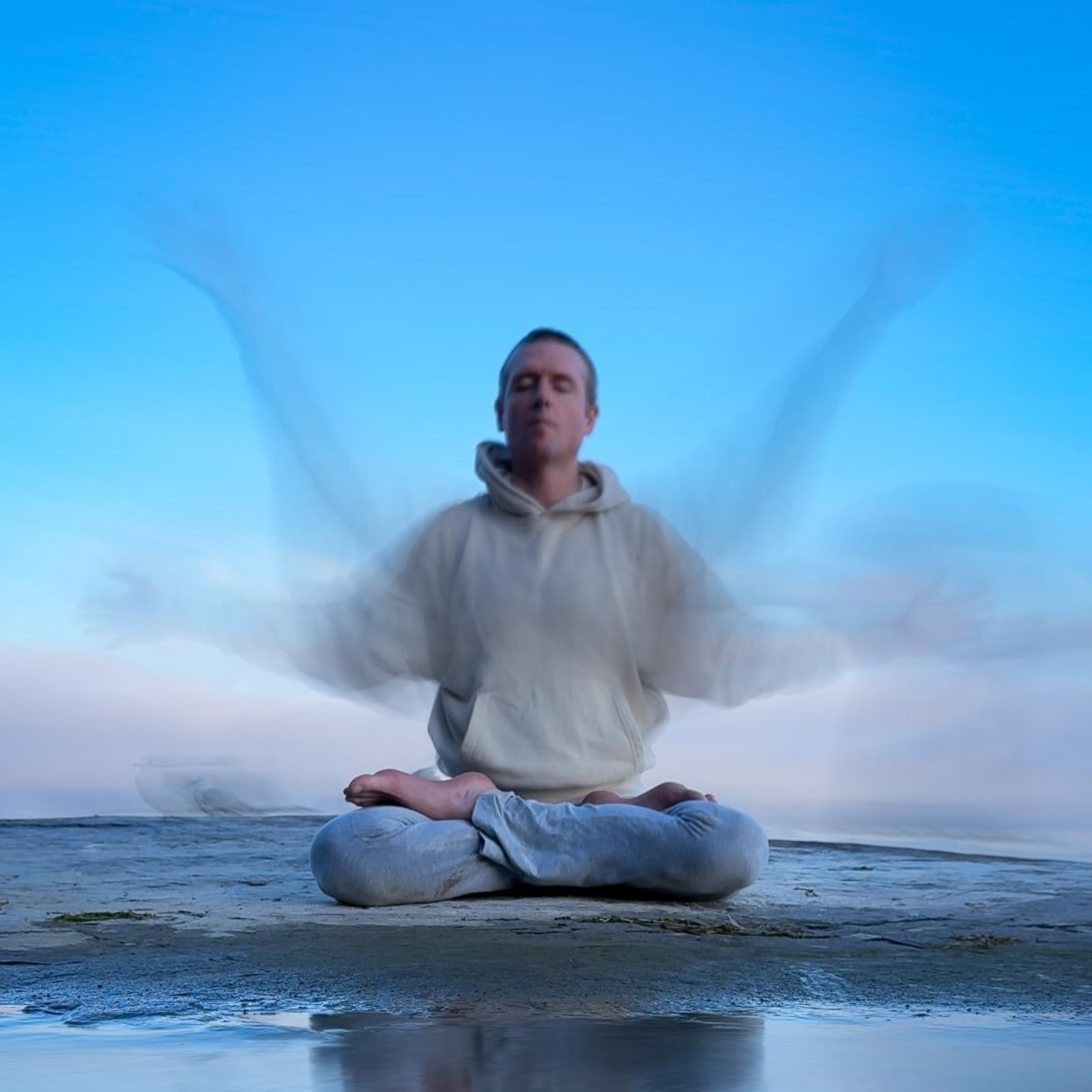
Nathaniel Maddison is a Vermont-based photographer and videographer. He uses chronophotography to trace the dance created by the flight patterns of birds and insects that join his sunrise yoga practice, layered against his own movement. He came to the technique somewhat by accident: doing yoga outdoors, he noticed birds repeatedly drifting into the background of his shots, and began layering the two together. His influences reach back to the roots of the medium in Muybridge's early motion studies, as well as multi-armed depictions of Hindu deities and the work of Spanish photographer Xavi Bou, both of which shaped his interest in rendering movement as a single, layered form. The resulting work reads as a kind of spiritual awakening, a visual representation of what Thich Nhat Hanh called interbeing: the idea that nothing exists independently, that everything, a star, a cloud, a flower, a person, relies on everything else to manifest.

Maddison has spent years living something close to a hermit's life, keeping his distance from people and instead keeping company with animals, whose consciousness he finds closer to the truth of interbeing than a culture that has grown disconnected from it. More recently, the level of crisis in his country has drawn him out of that solitude and into work that includes people directly, leading him toward citizen journalism and documentary photography. This shift has also opened a new technical direction: an emerging use of datamoshing to meld crowds of people into colorful, pulsating rivers of energy, extending his exploration of interbeing from the natural world into the human one.

763064888_18610823455001379_8664726153604544911_n.jpg

Eternal reflection (For Christina & Felicia)

Eternal_reflection_For_Christina__Felicia_Nathaniel_Maddison_Video.mp4

Finding synchronicity in human and bird movement

This is a "chronophotographic" work, a technique that traces back to the 19th century, when physiologist Étienne-Jules Marey coined the term to describe photographs that could capture and study the successive phases of a single movement, superimposed into one frame. Maddison applies that same principle to his own practice, shooting at 240 frames per second and layering the resulting footage so that motion accumulates within a single image, revealing itself all at once rather than freezing it at a single instant.

technique

video

format

portrait

duration

01:04

year

2026

Transport

WANT TO BRING ART INTO YOUR SPACE?

More from Nathaniel Maddison

More on digital art

Generative art
Generative art refers to a way of creating artworks using an autonomous system. In digital art, these are usually generated from code and algorithms created by the artist, often with certain predefined parameters or systems. Although these parameters guide the final outcome of the work, generative art is generally a surprising way to create artworks, as the results are often unexpected and the number of possible outcomes can be infinite.
AI
AI art is a branch of generative art that uses artificial intelligence. Unlike other generative artworks, AI artworks use specific complex algorithms and models derived from machine learning. The most common methods for creating AI art today are GANs (generative adversarial networks) or proprietary prompting platforms such as ChatGPT, Sora, Midjourney, or Dall-e.
3D
3D art uses 3D software such as Blender, Cinema4D, Houdini, or video game software such as Unity to create works of art. In 3D works, artists can either arrange assets (the 'objects' in a 3D artwork or world) that they have created themselves or purchased from other creators to create elaborate environments and scenes (an approach to 3D art called 'set dressing'), or specialize in sculpting, which involves creating their own objects and assets.
Photogrammetry
Photogrammetry is a specialized 3D technique that allows 3D objects to be created from numerous photographs taken of an object or scene from multiple angles. These photos are then compiled to determine the specific positioning, shape, and dimensions of the object in space, and then converted into a 3D model. Initially developed for engineering and urban planning, photogrammetry has become a way for artists to produce extremely accurate 3D models from real-life images.
Collage
An extension of the traditional, plastic approach to collage, digital collage involves searching for and cutting out multiple images, extracting them from their original context, and recomposing them in a new arrangement to create a work of art. Artists can use their own photographs or find images on the internet.
Illustration
Digital illustrations are created using software such as Adobe Illustrator, Photoshop, or Procreate. As with drawing on paper, the artist uses a stylus to sketch a figure or object, usually on a tablet, to construct a scene or artistic universe. Unlike traditional drawing methods, digital illustration is much more forgiving, as mistakes can be easily corrected and drawn elements and objects can be easily moved around within a scene.
Video
Video artworks primarily use a recording camera, but may sometimes include additional post-processing or editing to distort, modify or add additional elements to the image. Some artists use state-of-the-art recording equipment to create macro zoom-ins or time lapses, privileging fidelity to the subject matter. Others use additional softwares to significantly modify or warp the video, creating an alternative perspective on the world that surrounds us.

Collections with the artist

Where did you scan from

RATE YOUR EXPERIENCE