The New Human: Xanthopsia 164
The New Human: Xanthopsia 164
- Collage
- Pop
- Abstract
landscape
collage
01:00
2025

Hypertexte Sémantique: Xanthopsia 192
Treeskulltown

Fenêtre de l'âme: Xanthopsia 204
Treeskulltown

Peaceful Reveries: Xanthopsia 170
Treeskulltown

The Meaning: Xanthopsia 165
Treeskulltown

Le Tramage : Xanthopsia 161
Treeskulltown

The City With Organic Mapping: Xanthopsia 212
Treeskulltown

Subtitles: Xanthopsia 148
Treeskulltown

LIRE
Treeskulltown
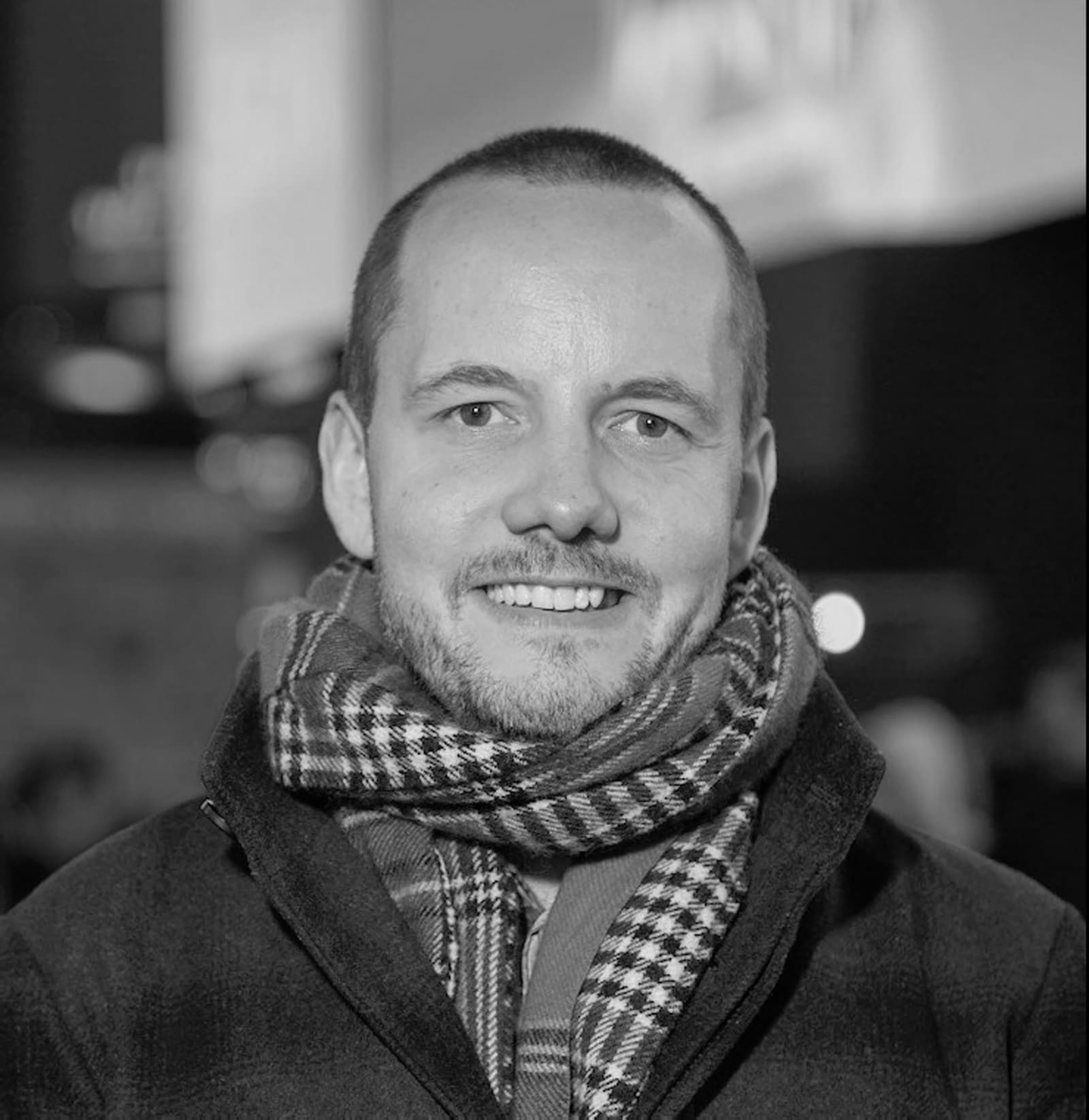
Treeskulltown is the conceptual avatar of a French multidisciplinary artist. For the last 4 years, he has been working in the field of digital art. Having grown up in the 80s, the emergence and development of computer technologies and techniques resonated with him and fuelled his curiosity. With 20 years of experimentation and hybridisation between physical and digital art under his belt, his work today is as much a personal quest as an artistic one. When he became a father, a need for simplicity and freedom, combined with the constraints of mobility, led him to return to the source of the desire to create and the pleasure of doing so, using organic materials (earth, paper, paint, cardboard, wood, etc.). It's a way of rediscovering meaning by naturally reconnecting with feelings and emotions. His aim is to develop a temporal parallel, a conversation, with the masters of classical art, to create a sub-reality to art history using mixed media animation techniques, thus creating an analogue palimpsest in digital strata.
Very involved in the crypto-artist community, his works are collected in Ethereum on FOUNDATION, in Tezos on OBJKT and in Bitcoin on GAMMA. Since 2022, his work has been exhibited and presented internationally at major events such as Art Crush Gallery, MOWNA, NFT NYC, NFT Japan, DAM Zine, NFC Lisbon, NFT Factory Paris, R HAUS Art Basel Miami, QUANTA Gallery London, IHAM NFT Gallery Paris. He was also selected in 2024 in The Hug 100 artists to watch and in the N3W Society Bookzine with the web3 agency: BRAWHAUS. His continual quest to reinvent himself and experiment provokes an emotional interaction with the viewer while guiding them with a subtle and conceptualised narrative.

The New Human: Xanthopsia 164
The Xanthopsia collection—a term evoking a perceptual condition in which the world appears tinged with yellow—is inspired by the work of Van Gogh, himself known for his perceptual disorders and his symbolic use of color. Basket of Crocus Bulbs is not one of his most famous paintings, but it embodies a tension between the natural (the bulbs as a potential for life) and its artistic representation, already shaped by an intense subjectivity.
2. The "New Human" and its "Subrealistic Echo": A Metaphysical Dialectic
- "New Human": A neologism evoking the individual reconstructed by technology—an algorithmic, fluid self, multiplied by avatars, social profiles, and generative AI. It is a being of potentialities, always in the process of becoming, but also in rupture with a fixed essence. (The concept of the "new human" resonates deeply with David Plastique's explorations in New Flesh 2.0 and its 2017 virtual gallery)—this idea of a detached subject, recomposed by technological logic, where identity is no longer an essence but a constellation of data, avatars, and algorithmic projections.
It is not a radical rupture, but rather a continuous metamorphosis—a digital becoming that defies fixed categories of the self. The "new human" operates in a liminal space between the biological and the artificial, between carnal memory and instantaneity. of flows.
This transformation becomes a phenomenological laboratory—a place where the ontological reconfiguration of the human being through the interface is played out, experimented with, and critiqued.
Here I touch on something essential: what if art today were less about representing the world than revealing its underlying metaphysics?
This duality raises profound philosophical questions:
- Identity and alienation: The screen becomes a distorting mirror, where the self is both amplified and dissolved. One thinks of Lacan and his mirror stage—but here, the reflection is mediated by technical and economic logics.
- Metaphysics of the virtual: The screen is not a simple surface; it is an ontological interface, a space where a reconfiguration of being is played out. The "new human" exists in a regime of ubiquity and instantaneity, defying the classical categories of time and space.
-------------------------
3. Rereading Basket of Crocus Bulbs: Between Organicity and Artificiality
Van Gogh painted bulbs as a promise of life—buried seeds, destined to bloom. In Xanthopsia, this image is transposed to the digital age:
- The "bulbs" become data stored in virtualized acrylic paint, stored identity potentialities, ready to be activated.
- The yellow color—xanthopsia—symbolizes both digital hyperstimulation (the blue light of screens, but also media glare) and a form of perceptual pathology: seeing the world through the filter of networks.
This rereading shifts the biological to the technological, questioning what remains "natural" in humans.
-------------------------
4. Scientifically Metaphysical Approach: Between Quantum Physics and Media Theory
- Contemporary Metaphysics: The notion of "echo" refers to theories of resonance (Hartmut Rosa) and complex systems where the observer affects the observed system (uncertainty principle in quantum physics). The screen is a measuring device that transforms what it shows.
- Neurophilosophy and perception: Xanthopsia as a perceptual disorder resonates with studies on digital-induced brain plasticity: our brain adapts to the screen, reconfiguring our relationship with reality.
- Epistemology of interfaces: The screen is not neutral; it structures cognition and identity. The "subrealism" of "the new human" reveals this invisible infrastructure—just as surrealism revealed the structures of the unconscious.
-------------------------
5. Conclusion:
"The New Human" in the Xanthopsia collection does not simply describe a condition; it performs it. By reactivating Van Gogh, they create a bridge between an artistic modernity that already struggled with perception and a digital postmodernity where the boundary between real and virtual is blurred.
Philosophically, this poses the The question: are we still "subjects" in the classical sense, or nodes in a network of data and images?
Scientifically, this invites a renewed metaphysics, where the screen becomes the site of a new phenomenology—and art, a laboratory for exploring its implications.
This approach is profoundly contemporary: it responds to the urgency of thinking about the human in a world saturated with representations, where the self is both overexposed and profoundly elusive.
The New Human: Xanthopsia 164
Tribute to Van Gogh : « Basket of Crocus Bulbs »
Original in :
Van Gogh Museum
Digital art version :
3840 x 2160 px / 4K MP4 / 198 Mo / 15 fps / 1/1 édition on @objktcom
collage
landscape
01:00
2025
More from Treeskulltown
More on digital art
Collections with the artist