The Developer: Xanthopsia 179
The Developer: Xanthopsia 179
- Collage
- Pop
- Abstract
portrait
collage
00:59
2025

Hypertexte Sémantique: Xanthopsia 192
Treeskulltown

Fenêtre de l'âme: Xanthopsia 204
Treeskulltown

Peaceful Reveries: Xanthopsia 170
Treeskulltown

The Meaning: Xanthopsia 165
Treeskulltown

Le Tramage : Xanthopsia 161
Treeskulltown

The City With Organic Mapping: Xanthopsia 212
Treeskulltown

Subtitles: Xanthopsia 148
Treeskulltown

LIRE
Treeskulltown
Treeskulltown is the conceptual avatar of a French multidisciplinary artist. For the last 4 years, he has been working in the field of digital art. Having grown up in the 80s, the emergence and development of computer technologies and techniques resonated with him and fuelled his curiosity. With 20 years of experimentation and hybridisation between physical and digital art under his belt, his work today is as much a personal quest as an artistic one. When he became a father, a need for simplicity and freedom, combined with the constraints of mobility, led him to return to the source of the desire to create and the pleasure of doing so, using organic materials (earth, paper, paint, cardboard, wood, etc.). It's a way of rediscovering meaning by naturally reconnecting with feelings and emotions. His aim is to develop a temporal parallel, a conversation, with the masters of classical art, to create a sub-reality to art history using mixed media animation techniques, thus creating an analogue palimpsest in digital strata.
Very involved in the crypto-artist community, his works are collected in Ethereum on FOUNDATION, in Tezos on OBJKT and in Bitcoin on GAMMA. Since 2022, his work has been exhibited and presented internationally at major events such as Art Crush Gallery, MOWNA, NFT NYC, NFT Japan, DAM Zine, NFC Lisbon, NFT Factory Paris, R HAUS Art Basel Miami, QUANTA Gallery London, IHAM NFT Gallery Paris. He was also selected in 2024 in The Hug 100 artists to watch and in the N3W Society Bookzine with the web3 agency: BRAWHAUS. His continual quest to reinvent himself and experiment provokes an emotional interaction with the viewer while guiding them with a subtle and conceptualised narrative.

The Developer: Xanthopsia 179
1. Artistic and Philosophical Conceptualization
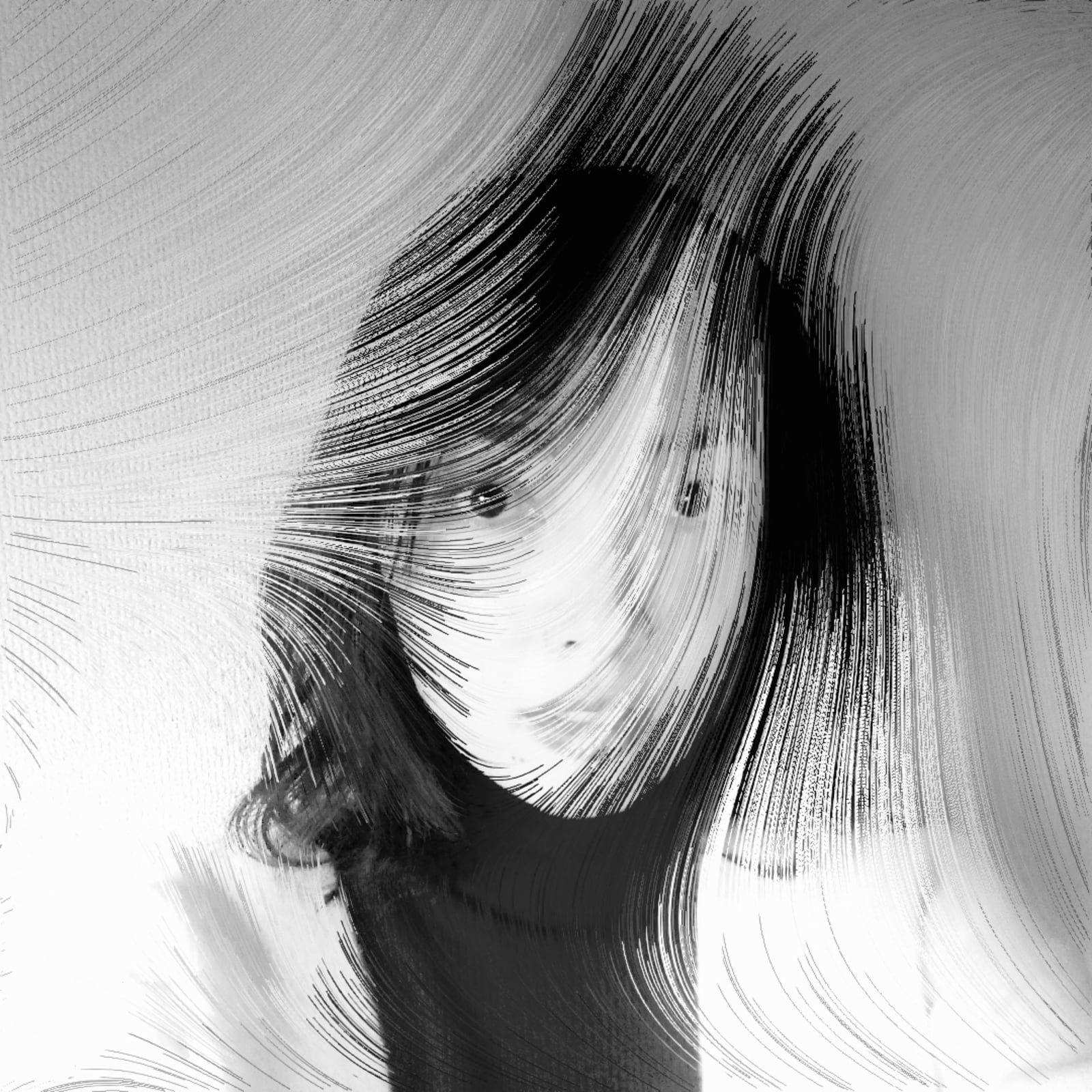
My work, "The Developer" revisits Van Gogh's Portrait of Patience Escalier by proposing a subrealist abstraction—a term that merges the subconscious and realism—to explore the tensions between figuration and abstraction. This approach embodies a metaphysical reflection on duality: the visible and the invisible, the tangible and the immaterial. By transposing Van Gogh's subject into a contemporary language, I question the notion of the creator (The Developer) as an entity that is simultaneously artistic, technological, and philosophical, evoking an organizing principle behind the apparent chaos of existence.
2. Technical Hybridization: Physical and Digital
The use of mixed media—acrylic on photographed canvas, combined with stop-motion digital animation—symbolizes the coexistence of analog and digital realities. Physical painting retains the materiality and gestural energy of Abstract Expressionism, while minimalist animation introduces a temporal dimension, reflecting the fluidity of perceptions in the digital subculture. This hybridization goes beyond mere aesthetics to become a metaphor for fragmented identities in the digital age.
3. The Xanthopsia Collection: A Utopian and Dualistic Vision
Xanthopsia, or "yellow vision," refers both to Van Gogh's iconic palette and to an altered perception, transforming the way we look at classical works. In "The Developer" yellow becomes a symbol of alchemical positivity, capable of transcending the "dark moments" evoked in the collection. This reinterpretation highlights the inherent duality of human and artistic nature: the balance between light and shadow, tradition and innovation. 4. Subrealist Abstraction as a Contemporary Language
By blending expressionist gestures and digital elements, I create a subrealist language that draws on the collective unconscious while integrating modern visual codes. The work becomes a contemplative allegory on the creative process itself. "The Developer" as a mediator between the real and the abstract, between the artist's hand and the artificial hand.
5. Reflection on Transcendence and Reinvention
My approach questions art's ability to reinvent itself through the ages. By digitally animating brushstrokes, I give duration to the ephemeral, recalling Van Gogh's own quest to capture the moving essence of life. The intentional cyclical and asynchronous animation of 16 images at 8 frames per second, as well as its meditative contemplation, amplified by the digital medium, invites an intimate connection with the work while expanding its symbolic scope.
6. Conclusion: A work that bridges yesterday and tomorrow
"The Developer" embodies a synthesis of artistic heritage and technological innovation. It goes beyond homage to become a manifesto on creation as a metaphysical act, where Van Gogh's yellow becomes the guiding principle of a quest for meaning in a hybrid world. Through this piece, the Xanthopsia collection affirms that art never dies—it transforms, like the perceptions it inspires.
The Developer: Xanthopsia 179:
Tribute to Van Gogh:
« Portrait of Patience Escalier »
in Sammlung Stavros S. Niarchos collection
Digital art version :
2160 x 3840 px / 4K MP4 / 116 Mo / 8 fps / 1/1 édition on @objktcom
collage
portrait
00:59
2025
More from Treeskulltown
More on digital art
Collections with the artist