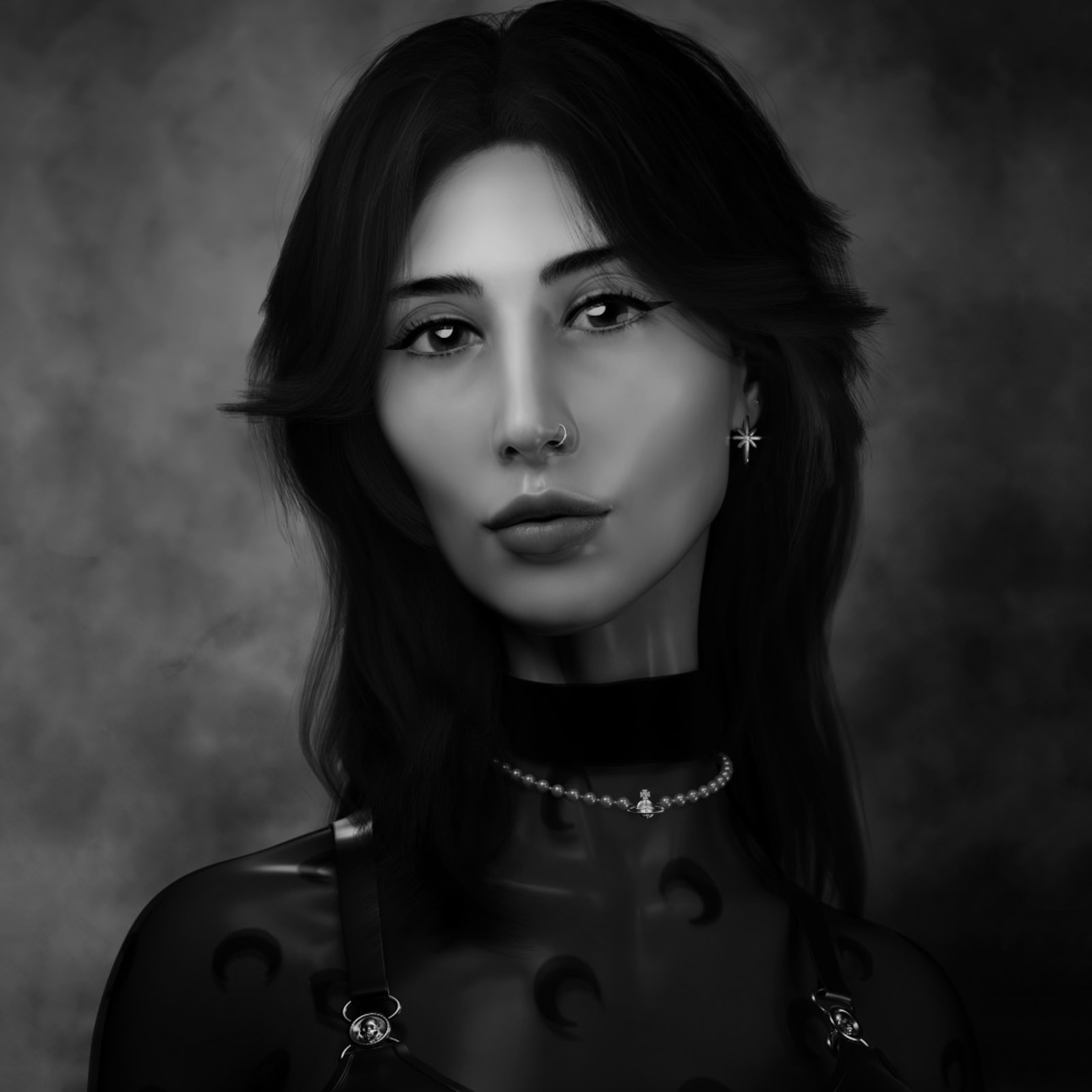
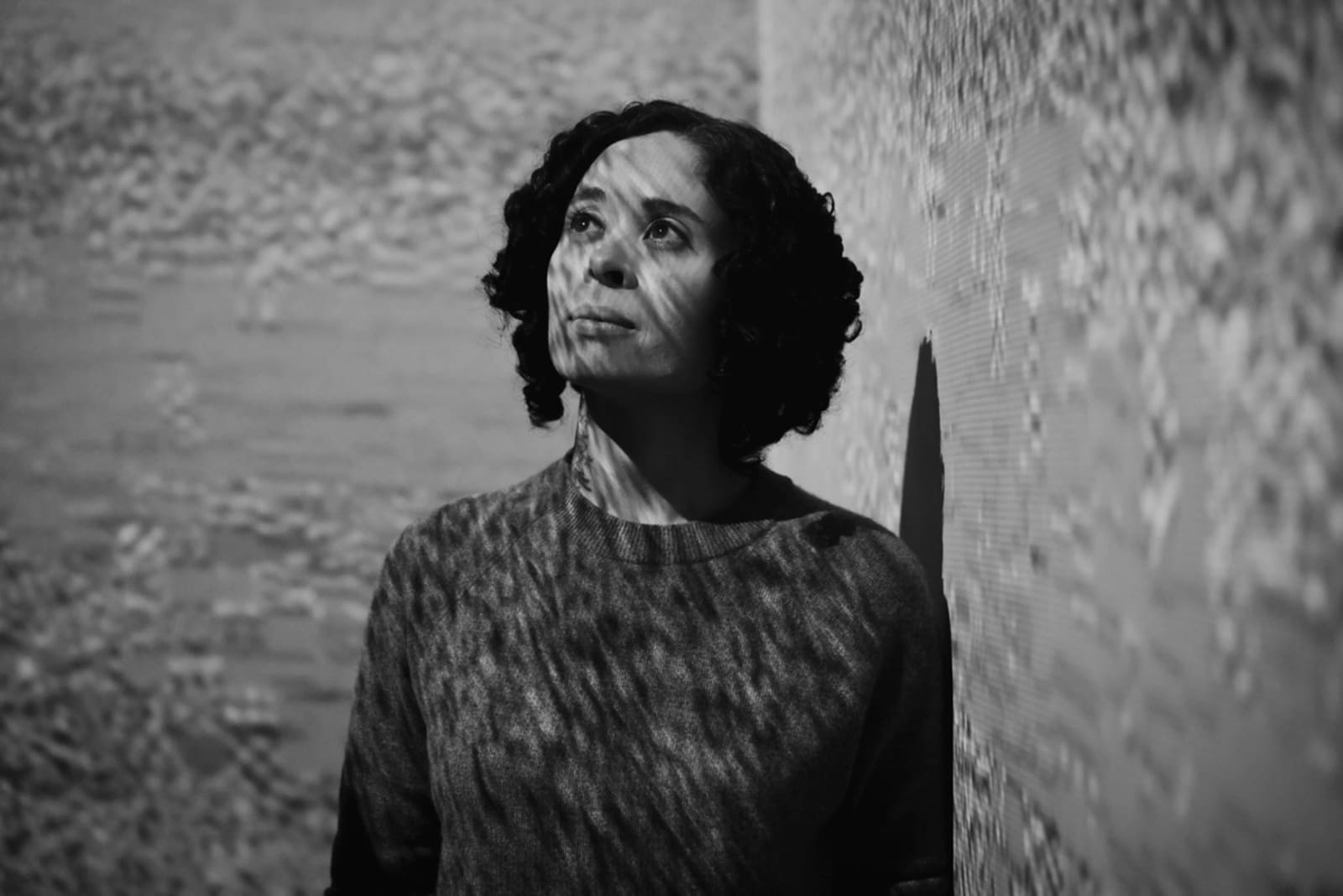
Lela Amparo’s creative journey began with music. Born and raised in Tucson, Arizona, this self-taught guitarist naturally gravitated toward film, photography, and travel, three pursuits that would become the foundation of her visual work. From Morocco to Norway, via France and Sweden where she now lives, she tirelessly captures images as she travels. For years, these photos lay dormant in boxes, until 2019, when she decided to give them a second life: she compiled datasets from her own photographs, organized by theme, and fed them into an artificial intelligence model (GAN) that she customized to develop a unique aesthetic of her own. She describes this process as a way of “cooking” her photographs: up to 500 original shots can be merged into a single work, giving rise to a sort of visual archetype, at the intersection of the tangible and the intangible. Rooted in photography, her approach is now fully established in the field of digital art, without abandoning film photography, which she continues to practice through the production of prints. Her visual world, dominated by deep purple hues, vibrant reds, and organic greens, explores the duality between nature and the digital realm, and bears the mark of her multicultural heritage (Native American, African American, Filipino, and Slovak) as well as a vaporwave and glitch aesthetic inherited from her childhood in the 1990s. More recently, she has taken this exploration even further by recycling and reworking her own AI-generated creations as part of an ongoing process of reinvention.

As an ambient music producer with over 11 million streams, Lela Amparo fuses her sonic and visual worlds to offer a multisensory experience, with the aim of transporting listeners and viewers to a parallel dimension. Her work has earned her international recognition: she has exhibited at Digital Art Week 2024 in London, Forgotten Places 2023 in Rome, and Contemporary Abstract 2023 in Kansas City, and completed an artist residency at Frameless in London in 2023. She has also been featured in Forbes Magazine (2024), Digital Arts Blog (2024), and AL-TIBA9 Art Magazine (2023).

Lela_Amparo_AI.jpg

Time We Have - Horizontal

Time_We_Have_-_Horizontal_Lela_Amparo_Generative_art.mp4

Seeing portals everywhere I look.

technique

generative art

format

landscape

duration

02:21

year

2024

Transport

WANT TO BRING ART INTO YOUR SPACE?

More from Lela Amparo

More on digital art

Generative art
Generative art refers to a way of creating artworks using an autonomous system. In digital art, these are usually generated from code and algorithms created by the artist, often with certain predefined parameters or systems. Although these parameters guide the final outcome of the work, generative art is generally a surprising way to create artworks, as the results are often unexpected and the number of possible outcomes can be infinite.
AI
AI art is a branch of generative art that uses artificial intelligence. Unlike other generative artworks, AI artworks use specific complex algorithms and models derived from machine learning. The most common methods for creating AI art today are GANs (generative adversarial networks) or proprietary prompting platforms such as ChatGPT, Sora, Midjourney, or Dall-e.
3D
3D art uses 3D software such as Blender, Cinema4D, Houdini, or video game software such as Unity to create works of art. In 3D works, artists can either arrange assets (the 'objects' in a 3D artwork or world) that they have created themselves or purchased from other creators to create elaborate environments and scenes (an approach to 3D art called 'set dressing'), or specialize in sculpting, which involves creating their own objects and assets.
Photogrammetry
Photogrammetry is a specialized 3D technique that allows 3D objects to be created from numerous photographs taken of an object or scene from multiple angles. These photos are then compiled to determine the specific positioning, shape, and dimensions of the object in space, and then converted into a 3D model. Initially developed for engineering and urban planning, photogrammetry has become a way for artists to produce extremely accurate 3D models from real-life images.
Collage
An extension of the traditional, plastic approach to collage, digital collage involves searching for and cutting out multiple images, extracting them from their original context, and recomposing them in a new arrangement to create a work of art. Artists can use their own photographs or find images on the internet.
Illustration
Digital illustrations are created using software such as Adobe Illustrator, Photoshop, or Procreate. As with drawing on paper, the artist uses a stylus to sketch a figure or object, usually on a tablet, to construct a scene or artistic universe. Unlike traditional drawing methods, digital illustration is much more forgiving, as mistakes can be easily corrected and drawn elements and objects can be easily moved around within a scene.
Video
Video artworks primarily use a recording camera, but may sometimes include additional post-processing or editing to distort, modify or add additional elements to the image. Some artists use state-of-the-art recording equipment to create macro zoom-ins or time lapses, privileging fidelity to the subject matter. Others use additional softwares to significantly modify or warp the video, creating an alternative perspective on the world that surrounds us.

Collections with the artist

  • Zeros__Ones_The_Brigadoon_Dispatch_AI.mp4
    Through the fog
    48 artworks
  • Sweet_Dreams_Kaoru_Tanaka_Generative_art.mp4
  • Shared_memories_Benjamin_Bardou_Photogrammetry.mp4
  • Cosmic_Ocean_Infinite_Mantra_AI.mp4
  • Between_the_four_stone_walls_the_echo_sounds_soothing_Yves_Peitzner_Generative_art.mp4
  • Sparkly_Sunset_-_Horizontal_Edurne_Andono_Video.mp4
  • Hyper_Mountains_Gaël_Corboz_3D.mp4
  • Where did you scan from

    RATE YOUR EXPERIENCE