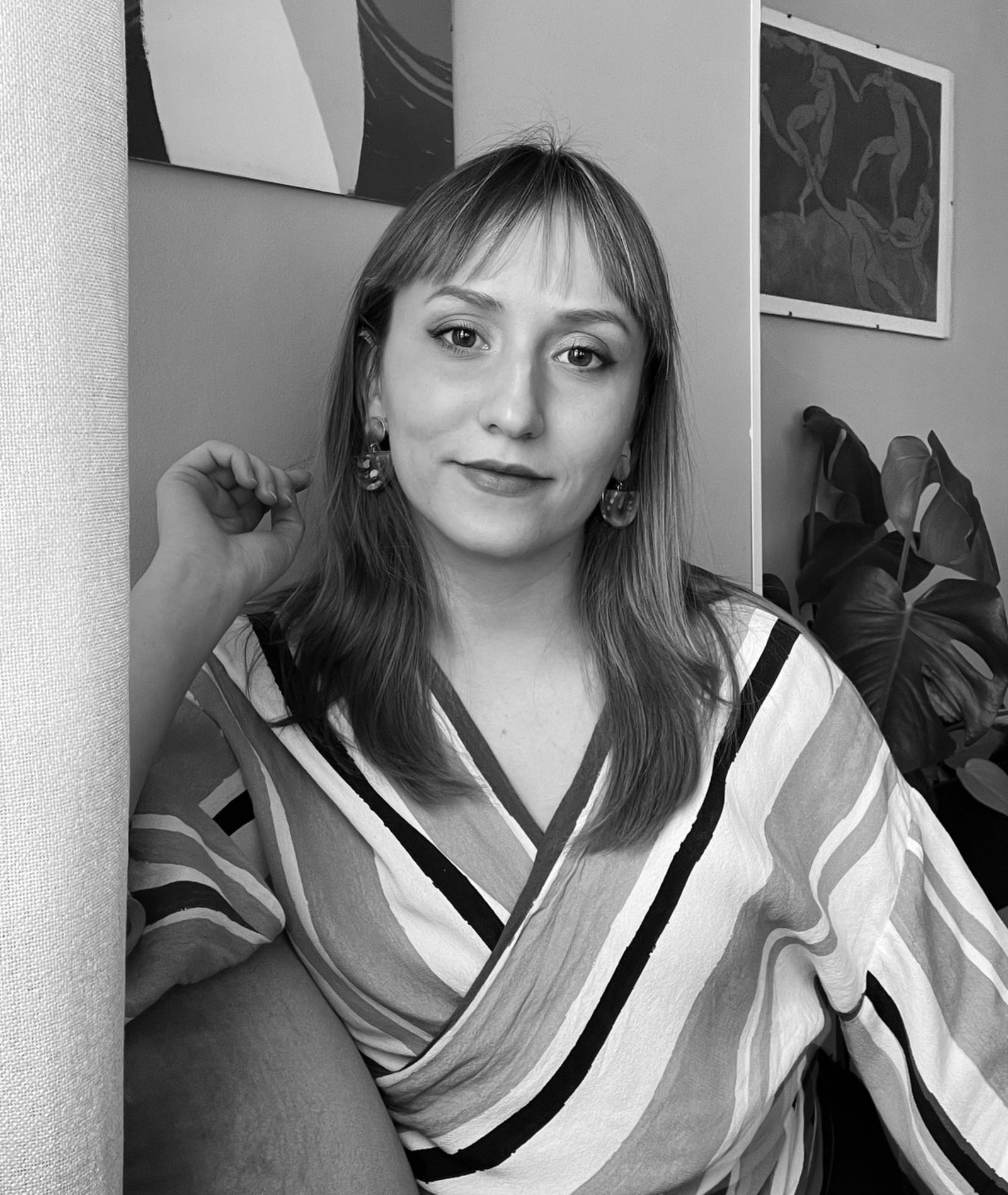
Yaren Esendemir is an Istanbul-based Turkish 3D media artist, trained in interior architecture, who builds immersive environments balancing realism with poetic abstraction. Drawing on architectural thinking and spatial storytelling, she explores the relationship between physical space and intangible elements (light, motion, and atmosphere), crafting carefully constructed, dreamlike worlds that viewers can step directly into. She approaches digital space as an "emotional architecture," a place where atmosphere becomes a narrative tool and the boundaries between reality, memory, and speculative futures blur. Her work often pairs abstract human ideas with the tangible reality of nature, so that the viewer feels the central idea physically rather than simply observing it. Working primarily in Unreal Engine, alongside Blender, 3ds Max, After Effects and Photoshop, she choreographs mood the way a director would, controlling weather, camera language, texture, and movement. Conceived for large screens and spatial installations, her immersive rooms aim to surround the audience in their atmosphere, with resilience and the quiet persistence of hope running through even her darkest scenes.

Esendemir's path into media art began while she was still working as an interior architect, building the piece Dream World late at night on her laptop. It was the work through which she was first discovered, and it redirected her professional path. Her series include Eternal Seasons, What the Night Keeps, Time Downward, and All That Finds the Sea. She has also been invited by professors from the university where she studied interior architecture to speak about her journey at an interregional conference.


Yaren_Esendemir.png

Eternal Seasons - Autumn II - Vertical

eternal_seasons_autumn_II_V1_4K.mp4

Des portails cristallins s'entrouvrent pour dévoiler un royaume de lumière et de merveille. Attiré par leur éclat, un renard apparaît, observateur silencieux, entre le connu et l'invisible.

technique

3d

format

portrait

duration

02:00

year

2026

Transport

WANT TO BRING ART INTO YOUR SPACE?

More from Yaren Esendemir

More on digital art

Generative art
Generative art refers to a way of creating artworks using an autonomous system. In digital art, these are usually generated from code and algorithms created by the artist, often with certain predefined parameters or systems. Although these parameters guide the final outcome of the work, generative art is generally a surprising way to create artworks, as the results are often unexpected and the number of possible outcomes can be infinite.
AI
AI art is a branch of generative art that uses artificial intelligence. Unlike other generative artworks, AI artworks use specific complex algorithms and models derived from machine learning. The most common methods for creating AI art today are GANs (generative adversarial networks) or proprietary prompting platforms such as ChatGPT, Sora, Midjourney, or Dall-e.
3D
3D art uses 3D software such as Blender, Cinema4D, Houdini, or video game software such as Unity to create works of art. In 3D works, artists can either arrange assets (the 'objects' in a 3D artwork or world) that they have created themselves or purchased from other creators to create elaborate environments and scenes (an approach to 3D art called 'set dressing'), or specialize in sculpting, which involves creating their own objects and assets.
Photogrammetry
Photogrammetry is a specialized 3D technique that allows 3D objects to be created from numerous photographs taken of an object or scene from multiple angles. These photos are then compiled to determine the specific positioning, shape, and dimensions of the object in space, and then converted into a 3D model. Initially developed for engineering and urban planning, photogrammetry has become a way for artists to produce extremely accurate 3D models from real-life images.
Collage
An extension of the traditional, plastic approach to collage, digital collage involves searching for and cutting out multiple images, extracting them from their original context, and recomposing them in a new arrangement to create a work of art. Artists can use their own photographs or find images on the internet.
Illustration
Digital illustrations are created using software such as Adobe Illustrator, Photoshop, or Procreate. As with drawing on paper, the artist uses a stylus to sketch a figure or object, usually on a tablet, to construct a scene or artistic universe. Unlike traditional drawing methods, digital illustration is much more forgiving, as mistakes can be easily corrected and drawn elements and objects can be easily moved around within a scene.
Video
Video artworks primarily use a recording camera, but may sometimes include additional post-processing or editing to distort, modify or add additional elements to the image. Some artists use state-of-the-art recording equipment to create macro zoom-ins or time lapses, privileging fidelity to the subject matter. Others use additional softwares to significantly modify or warp the video, creating an alternative perspective on the world that surrounds us.

Collections with the artist

Where did you scan from

RATE YOUR EXPERIENCE