Compost XII - Vertical
Compost XII - Vertical
- 3D
- Photogrammetry
- Nature
- Glitch
portrait
3d
02:45
2023

Compost XIII - Orbital Road
Lauren Moffatt
Compost XII - Vertical
Lauren Moffatt

Compost VIII - A Wave in the Mind
Lauren Moffatt

Compost XI - Nocturnal Crossing
Lauren Moffatt

Compost XV - Vertical
Lauren Moffatt

Compost VI - Vertical
Lauren Moffatt
Lauren Moffatt is an Australian-born artist working with video, performance and immersive technologies. Trained in painting, new media and audiovisual creation at UNSW Art & Design, Université Paris VIII and Le Fresnoy, she combines conventional, obsolete and emerging tools to build universes that span physical and virtual space. Her practice grows out of constant experimentation: she repurposes algorithms designed for other ends to generate digital geometry, and looks for textures that connect the physical world to the way it is digitized. The result takes the form of installations, immersive simulations and moving images that can leave viewers unsure whether they are looking at a painting or a digital object. Through them, she explores the ambiguous subjectivity of connected bodies and the frictions between virtual and physical worlds, digital and organic life.
Based in Valencia, her work has been presented at institutions and festivals including the Centre Pompidou, Villa Medici, ZKM, FACT Liverpool, Sónar, SXSW and the Sundance Film Festival. A 2025 laureate of the S+T+ARTS residency programme, she has been awarded or nominated for prizes including the DKB VR Art Prize, the Neuflize Innovation Grant and the LOOP Discovery Award. Her works are held in public and private collections such as the Bibliothèque nationale de France, The Fabbula Collection and the MAKMA Collection.

Compost XII - Vertical
The Flowers for Suzanne Clair series is inspired by The Crystal World (1966), J. G. Ballard’s disaster novel in which an apocalyptic mineralization spreads across the world, turning everything in its path to crystal. The story is told mostly through its protagonist, Edward Sanders, as he witnesses the doom unfolding in beautiful prose describing the chilling opulence of the destruction. Suzanne Clair is a former lover of Sanders, and we encounter her through his lens as a tragic, lost soul. Rather than an ending, Suzanne perceives the crystal as an opportunity for a different kind of life, and her optimistic view stands out awkwardly in contrast with the other foreground figures. She seems like a naive, lonely victim.
Removed from this narrow context, Suzanne's ability to perceive the crisis as something other than an immediate existential threat, her willingness to engage with alternatives to doom, appears more interesting than the attitudes of the male counterparts who condescend her. It would have been interesting to see The Crystal World through Suzanne's eyes, to understand her as more than a prop character, and this nostalgia for a lost voice is the origin of the world of Flowers for Suzanne Clair.
-
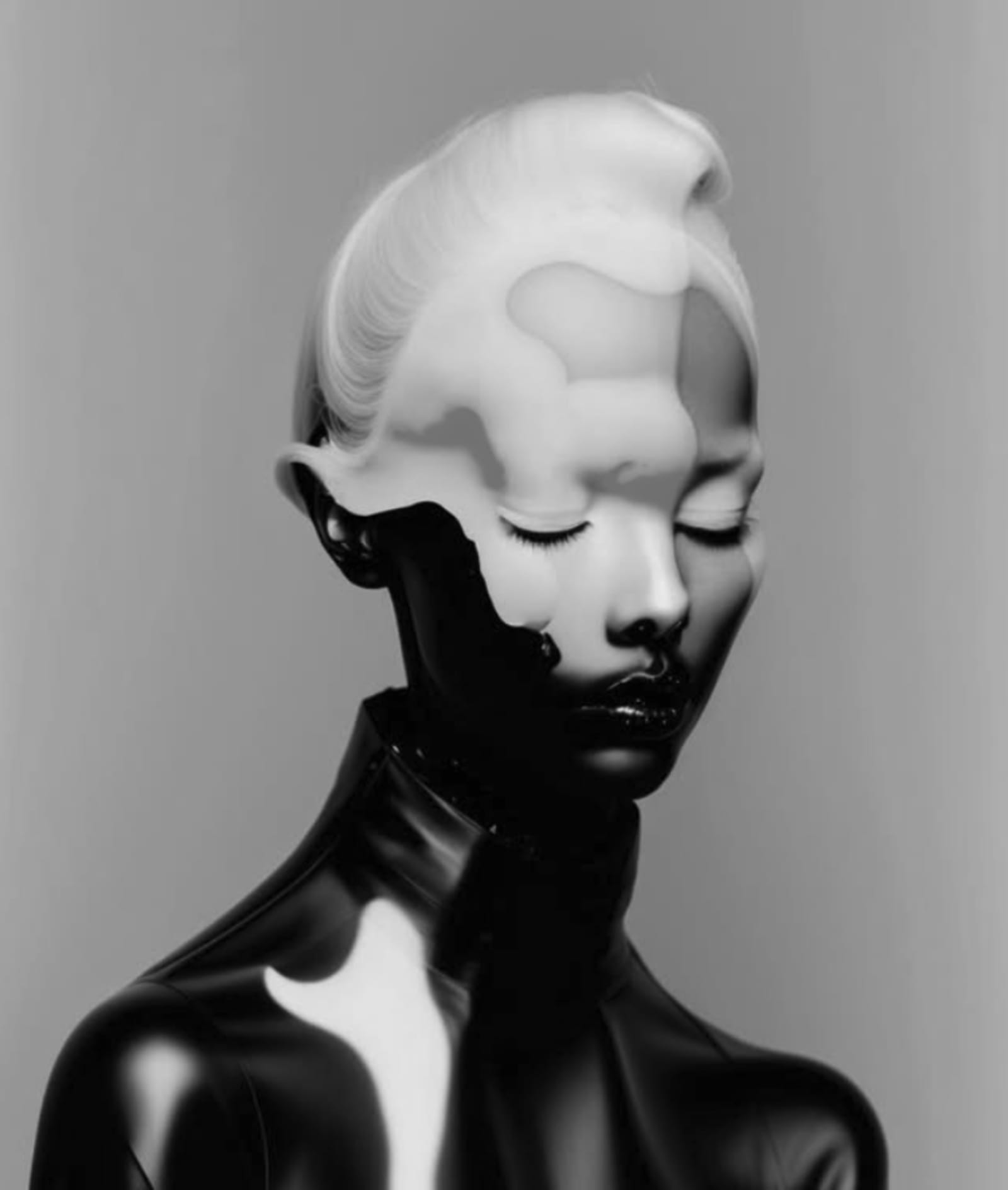
Within it, the Compost series explores forms of deceleration and regeneration, using video game technologies fused with conventional painting techniques.
The digital images and sculptures take sideroads, following a process made of accidents and dialogues with machines. This singular photogrammetry practice consists of working with a reduced number of photographs, varying focal lengths, photographing subjects too close, or causing willful errors when photographing moving subjects. The textures are then painted and blended into compositions in 3D modeling software.
By creating a digital strangeness and effects that associate the sublime with digital defects, these interventions return a measure of disorder and indeterminacy to the living.
3d
portrait
02:45
2023