The Cyclops' Path Remains Unchanged: Xanthopsia 156
The Cyclops' Path Remains Unchanged: Xanthopsia 156
- Collage
- Pop
- Abstract
portrait
collage
00:59
2025

Hypertexte Sémantique: Xanthopsia 192
Treeskulltown

Fenêtre de l'âme: Xanthopsia 204
Treeskulltown

Peaceful Reveries: Xanthopsia 170
Treeskulltown

The Meaning: Xanthopsia 165
Treeskulltown

Le Tramage : Xanthopsia 161
Treeskulltown

The City With Organic Mapping: Xanthopsia 212
Treeskulltown

Subtitles: Xanthopsia 148
Treeskulltown

LIRE
Treeskulltown
Treeskulltown is the conceptual avatar of a French multidisciplinary artist. For the last 4 years, he has been working in the field of digital art. Having grown up in the 80s, the emergence and development of computer technologies and techniques resonated with him and fuelled his curiosity. With 20 years of experimentation and hybridisation between physical and digital art under his belt, his work today is as much a personal quest as an artistic one. When he became a father, a need for simplicity and freedom, combined with the constraints of mobility, led him to return to the source of the desire to create and the pleasure of doing so, using organic materials (earth, paper, paint, cardboard, wood, etc.). It's a way of rediscovering meaning by naturally reconnecting with feelings and emotions. His aim is to develop a temporal parallel, a conversation, with the masters of classical art, to create a sub-reality to art history using mixed media animation techniques, thus creating an analogue palimpsest in digital strata.
Very involved in the crypto-artist community, his works are collected in Ethereum on FOUNDATION, in Tezos on OBJKT and in Bitcoin on GAMMA. Since 2022, his work has been exhibited and presented internationally at major events such as Art Crush Gallery, MOWNA, NFT NYC, NFT Japan, DAM Zine, NFC Lisbon, NFT Factory Paris, R HAUS Art Basel Miami, QUANTA Gallery London, IHAM NFT Gallery Paris. He was also selected in 2024 in The Hug 100 artists to watch and in the N3W Society Bookzine with the web3 agency: BRAWHAUS. His continual quest to reinvent himself and experiment provokes an emotional interaction with the viewer while guiding them with a subtle and conceptualised narrative.

The Cyclops' Path Remains Unchanged: Xanthopsia 156
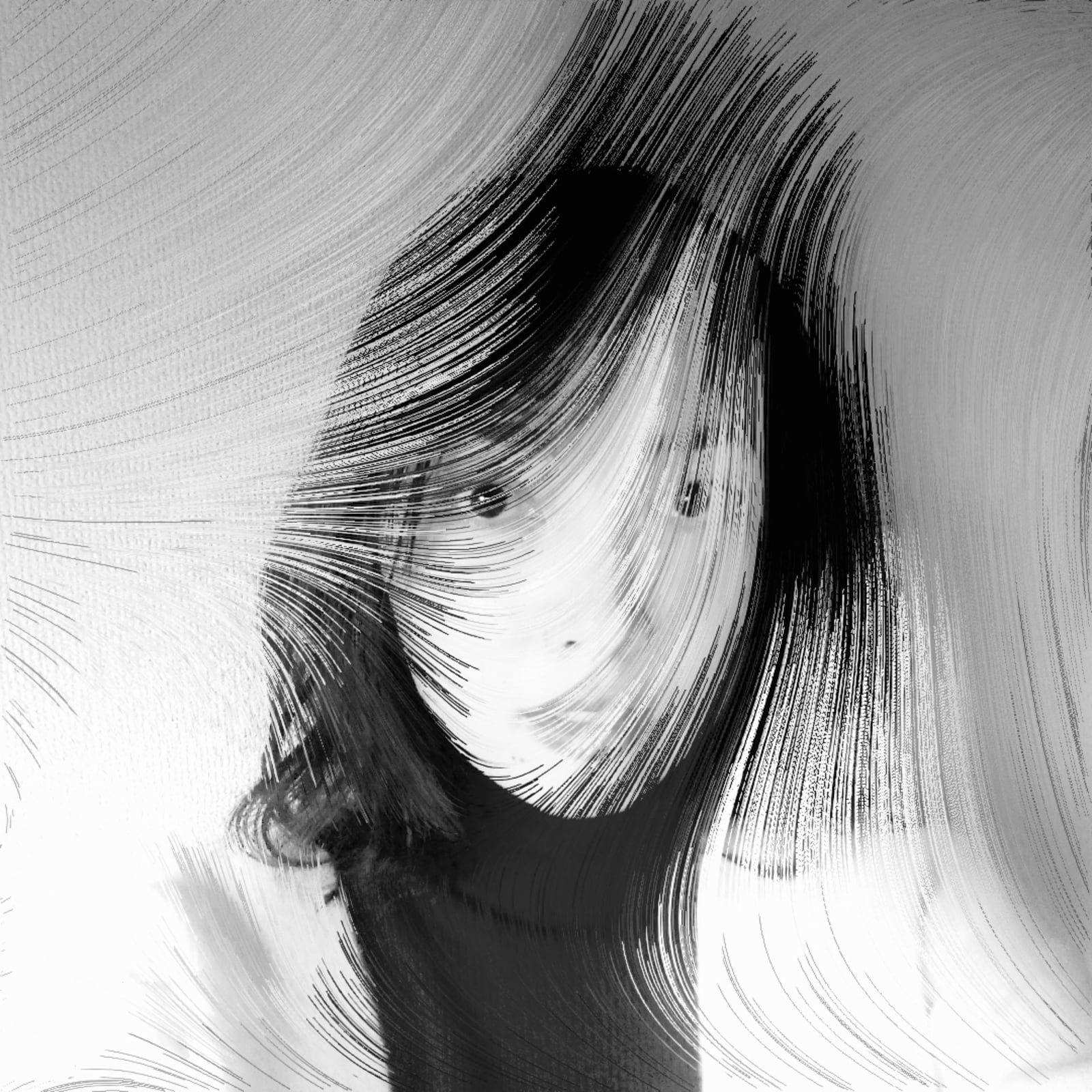
This work is part of a subrealist abstraction approach—a visual language where the familiar and the dreamlike merge—to question the invisible rituals that structure existence. The title, "The Cyclops' Path Remains Unchanged," serves as an allegory of Polyphemus's repetitive and solitary journey, a mirror of Van Gogh's little-known routine: purchasing pigments, acquiring prints, walking to the fields. These ordinary gestures, although constitutive of his identity and practice, remain in the shadow of his legend.
By hybridizing acrylic paint on canvas (impasto texture, thick layers reminiscent of Van Gogh's material) and frame-by-frame digital animation, I create a dialogue between the tangible and the immaterial. The photograph of the physical canvas serves as the basis for a minimalist digital intervention—perhaps superimposed light paths evoking movement, or animated sequences suggesting the repetition of gestures. The subrealist treatment deconstructs the realism of the original to accentuate Abstract Expressionism through movement: the brushstrokes become flows, the Japanese prints that fascinated Van Gogh become windows onto a mental elsewhere.
Philosophical Profoundness: Cyclicity, Isolation, and Duality
The Cyclops Polyphemus—a being with a single, literal and metaphorical vision—symbolizes both the singularity of Van Gogh's gaze and his social isolation. His "unchanging path" refers to the routines that, although invisible, underlie creation and the human condition. At the same time, the Japanese print in the original portrait represents a window onto an exotic ideal, a dreamed-of elsewhere that contrasts with the painter's reality.
This duality—between routine and dream, isolation and cultural connection—is at the heart of your reflection. It echoes the tensions dear to Van Gogh: order and chaos, nature and culture, suffering and beauty. By digitally animating these elements, I give a moving form to this dialectic, suggesting that everyday life itself is a repeated, almost ritualistic performance that escapes our attention.
Conclusion: A Digital Archaeology of Gesture
The Cyclops' Path Remains Unchanged is not simply a tribute to Van Gogh and his approach: it unearths the hidden side of his practice and, in doing so, questions our own invisible routines. By blending classical techniques (palette knife painting, impasto) and digital language (minimalist animation, superposition effects), I propose an archaeology of the artistic gesture—where subrealism serves as a bridge between yesterday and today, between the physical and the virtual. This work asserts that digitally augmented art can reveal the imperceptible layers of past works, and that the everyday—even that of a cyclops or a cursed genius—deserves to be contemplated as the silent theater of our humanity.
Tribute to Van Gogh: « Self-Portrait with Japanese Print »
Original at : Kunstmuseum Basel
#treeskulltown digital art version :
2160 x 3840 px / 4k MP4 / 97,8 Mo / 8 fps / 1/1 édition
On @objktcom :
https://objkt.com/tokens/KT1SPfxmyYFdQtFdc8cr9o1Mgkc6RU3LBKHP/161
collage
portrait
00:59
2025
More from Treeskulltown
More on digital art
Collections with the artist