Geo-Pixel Drift: Hong Kong
Geo-Pixel Drift: Hong Kong
- Pixel
- Figurative
landscape
pixel
04:59
2025


Mirim Chu (b. 1982) is a Seoul-based media artist who visualizes the intersection of urban structures and digital networks. Her practice explores the "interfaces" where physical cities and online environments overlap, utilizing the square pixel, the fundamental unit of the digital screen, and the geometric patterns found in satellite maps as her primary visual modules. Drawing from her professional background as a UI designer in the early 2000s, Chu investigates the nostalgia of the early digital era and the experience of growing up in planned "new towns." Her work uncovers the hidden systems of control and data-driven structures within our daily environments, weaving together disparate landscapes into fluid, interconnected narratives across painting, installation, and video. Recently, her practice has been driven by a growing interest in the data structures that underpin both the web and the contemporary city. Through this research, she develops works that evoke the patterns and logic of a data-driven society, constructing complex narratives that reflect digital environments and urban sensibilities across painting, installation, and video. In her latest video installations, she proposes intersected digital-urban landscapes that invite viewers to reconsider and reflect on the realities of everyday contemporary life.
Chu’s career has seen significant recognition on the international stage. In 2025, her work was featured in the Frieze Seoul Focus Asia section and the Seoul Museum of Art (SeMA) touring exhibition Kitsch and Pop in Hong Kong and Shanghai. Building on this momentum, she is currently pursuing an MFA in Media Art at Yonsei University’s Graduate School of Communication and Arts. Her upcoming projects for 2026 include exhibitions at the Gyeongnam Art Museum and the Museum of Contemporary Art Busan, where she will continue to explore contemporary daily life through complex, data-inflected video installations.
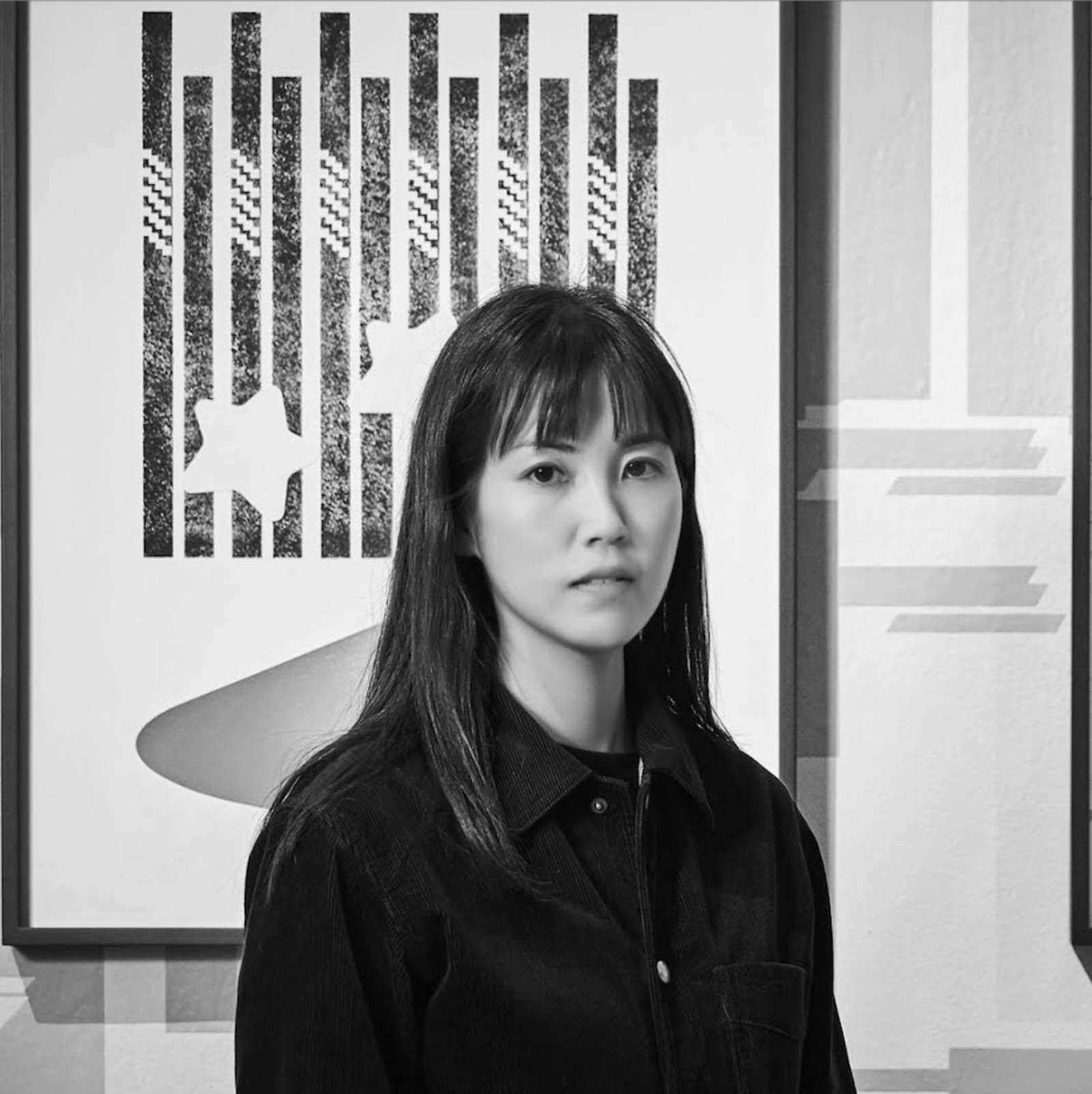
Geo-Pixel Drift: Hong Kong
The artist establishes the web and the city as the primary interfaces of contemporary daily life, formally exploring the structural rhythms and sensory densities inherent in these distinct environments. Centering her work on visual apparatuses, namely pixels and satellite maps, she constructs sensory landscapes where micro-units and macro-perspectives, as well as immersion and distance, intersect.
The pixel serves as both the smallest unit of an image and the most minute layer of digital sensation, acting as the starting point for deconstructing and reconstructing the structure of the screen surface. Conversely, the satellite perspective flattens the city, providing a distanced gaze that reveals the frameworks of structures, flows, and interfaces that cannot be experienced in our daily physical movements. Through this viewpoint, the artist reduces space to a schematic pattern and overlays it with the sensory units of pixels, rearranging the relationship between the city and the web into a new formal language.
A particularly noteworthy aspect of her practice is that she frequently explores, collects, and formalizes structures of places she has never physically visited, navigating solely via satellite maps. This remote sensation represents a new mode of exploration in the digital age—a sensory practice of traveling through space via data and imagery without physical movement. This method of imagining and visualizing unvisited places touches upon the sensory gap between physical reality and virtual environments, simultaneously evoking the estrangement and the formal order inherent in urban structures.
This methodology resonates with the perception of the city presented in Charles Dickens's A Tale of Two Cities. Just as Dickens constructs London and Paris as emotional terrains layered with differing sentiments, memories, and relationships, the artist views the city not merely as a geographical entity but as an emotional landscape where sensation, imagination, and memory overlap. She weaves the rhythms between cities together like a game of cat’s cradle.
The new work featured in this exhibition is based on the structures of Bundang, a "First Generation New Town" where the artist’s memories of growing up reside, and Hong Kong, a city she has navigated through the satellite view of web maps but has yet to visit. The images of these two cities are transformed into pixelated patterns that intersect within the video, forming a nonlinear and fluid landscape where the strange and the familiar, memory and imagination, are superimposed. Through this, the artist proposes a new visual order on the surface of the screen: one where sensation and distance, memory and exploration, converge.
pixel
landscape
04:59
2025
More from Mirim Chu
More on digital art
Collections with the artist