Alexandre Tamisier

France

Alexandre Tamisier is a motion designer and 3D artist from Clermont-Ferrand, France. After earning a professional degree in graphic design, he immersed himself in the world of digital art, quickly specializing in 3D design. With a strong focus on mastering industry-leading software such as Houdini and Redshift, Alexandre has honed his skills in modeling, animation, and simulations. Houdini enables him to create intricate digital landscapes and dynamic animations, while Redshift helps him finalize and render his stunning visual compositions. His work reflects a deep understanding of both the technical and creative aspects of 3D art.

Alexandre’s work has been showcased at universities in the United States (Baltimore, New York), in his hometown in France, and in commercial stores in Hong Kong. His artistic universe is heavily influenced by his love for science-fiction imagery, which inspires him to craft scenes of lost civilizations, untamed nature, and alien worlds. This sci-fi fascination is intertwined with his interest in the natural world, particularly the evolution of plant and animal species. The work of pioneers such as Ernst Haeckel, along with artists like Sara Masuger, Ivan Seal, and The Caretaker, provides an endless source of inspiration for his evocative digital art.

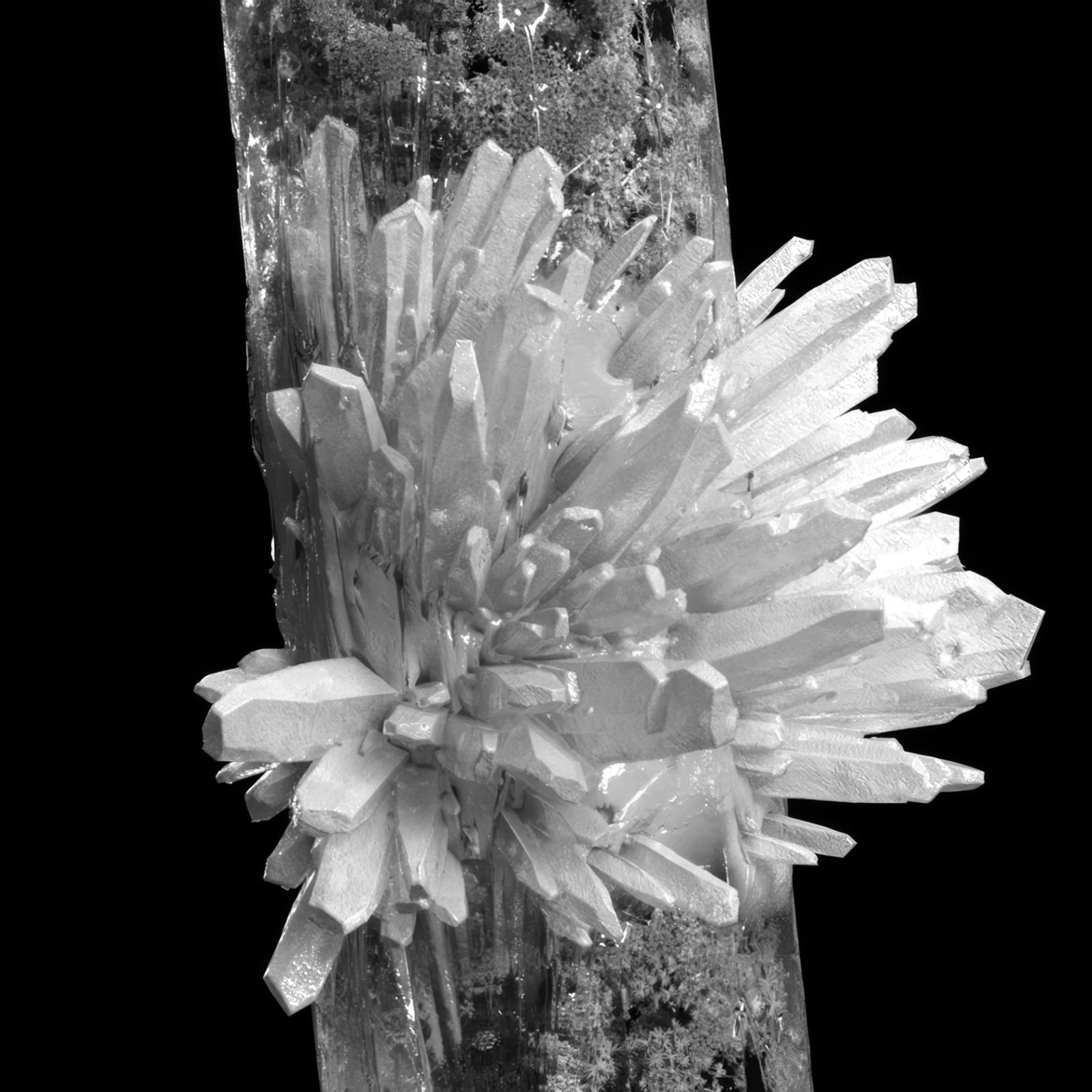
Alexandre_Tamisier_3D.jpeg

Rebirth - vertical

Rebirth_-_vertical_Alexandre_Tamisier_3D.mp4
Alexander’s artistic world echoes his passion for the fictional science visuals that fascinate him and inspire scenes of lost civilizations, delusional natures and alien planets. This first inspiration joins his fascination for nature in general, especially for the living world.
technique

3d

format

portrait

duration

10:00

year

n/a

WANT TO BRING ART INTO YOUR SPACE?

More from Alexandre Tamisier

More on digital art

Generative art
Generative art refers to a way of creating artworks using an autonomous system. In digital art, these are usually generated from code and algorithms created by the artist, often with certain predefined parameters or systems. Although these parameters guide the final outcome of the work, generative art is generally a surprising way to create artworks, as the results are often unexpected and the number of possible outcomes can be infinite.
AI
AI art is a branch of generative art that uses artificial intelligence. Unlike other generative artworks, AI artworks use specific complex algorithms and models derived from machine learning. The most common methods for creating AI art today are GANs (generative adversarial networks) or proprietary prompting platforms such as ChatGPT, Sora, Midjourney, or Dall-e.
3D
3D art uses 3D software such as Blender, Cinema4D, Houdini, or video game software such as Unity to create works of art. In 3D works, artists can either arrange assets (the 'objects' in a 3D artwork or world) that they have created themselves or purchased from other creators to create elaborate environments and scenes (an approach to 3D art called 'set dressing'), or specialize in sculpting, which involves creating their own objects and assets.
Photogrammetry
Photogrammetry is a specialized 3D technique that allows 3D objects to be created from numerous photographs taken of an object or scene from multiple angles. These photos are then compiled to determine the specific positioning, shape, and dimensions of the object in space, and then converted into a 3D model. Initially developed for engineering and urban planning, photogrammetry has become a way for artists to produce extremely accurate 3D models from real-life images.
Collage
An extension of the traditional, plastic approach to collage, digital collage involves searching for and cutting out multiple images, extracting them from their original context, and recomposing them in a new arrangement to create a work of art. Artists can use their own photographs or find images on the internet.
Illustration
Digital illustrations are created using software such as Adobe Illustrator, Photoshop, or Procreate. As with drawing on paper, the artist uses a stylus to sketch a figure or object, usually on a tablet, to construct a scene or artistic universe. Unlike traditional drawing methods, digital illustration is much more forgiving, as mistakes can be easily corrected and drawn elements and objects can be easily moved around within a scene.
Video
Video artworks primarily use a recording camera, but may sometimes include additional post-processing or editing to distort, modify or add additional elements to the image. Some artists use state-of-the-art recording equipment to create macro zoom-ins or time lapses, privileging fidelity to the subject matter. Others use additional softwares to significantly modify or warp the video, creating an alternative perspective on the world that surrounds us.

Collections with the artist

  • Venus_-_Horizontal_Stuart_Ward_3D.mp4
    Acropolis
    30 artworks
  • Orange_Days_EM!_Collage.mp4
  • Into_The_Abyss_Jessica_Avarello_3D.mp4
  • Magic_Meadow_Polina_Bulgakova_3D.mp4
  • SOFTER_WATER_Roxi_Basa_3D.mp4
  • CARYATID_-_Horizontal_Vincent_Viriot_3D.mp4
  • Royal_Comp_Alexandre_Tamisier_3D.mp4
  • Door_To_Infinity_4_-_Vertical_Morgane_Soulier_AI.jpeg
  • Human_Flux_Jérôme_Delapierre_Video.mp4
  • +500
    artists
    View more
    +10k
    artworks
    View more

    Where did you scan from

    RATE YOUR EXPERIENCE